Roberto Loiacono
Roberto Loiacono in 1985, during the years of study at the Institute for Figurative Arts "G.B. Bodoni ”of Turin (where he graduated in 1987 with the evaluation of 50 sixtieths) writes produces and realizes a technical documentary on the use of graphic equipment. It is still used today as educational material.
7/28/20255 min read
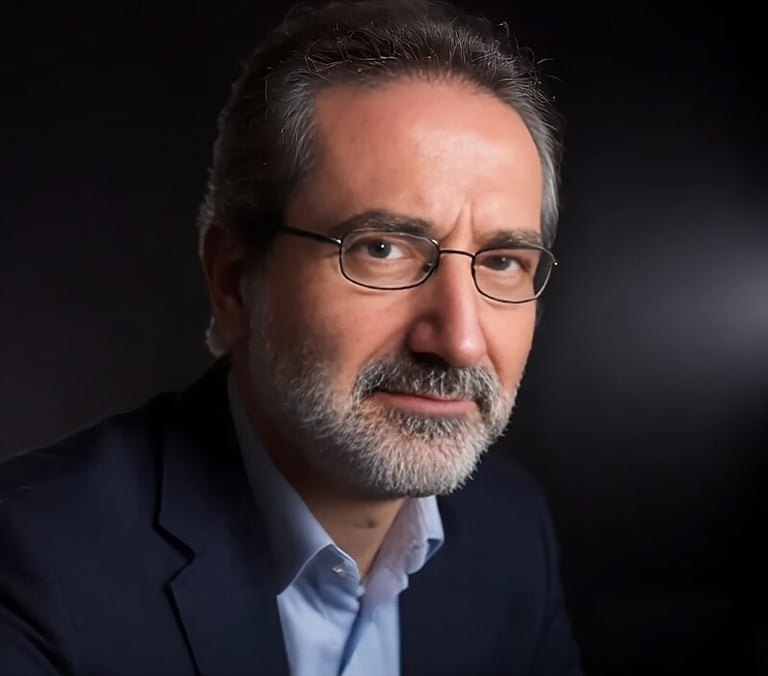
Can you explain to the audience your career?
I began studying in 1985 at the Institute of Figurative Arts in my hometown, Turin. In 1987, my classmates and I founded F.D.T., which in 1999 became F.D.T. Studio, my graphic design studio and production company, through which I self-finance my film projects. I also studied for four years, from 1990 to 1994, at Ermanno Olmi's Ipotesi Cinema Institute in Bassano del Grappa. In the following years, I completed several projects (five feature films and five shorts), the most important of which was ZONA 3, the only Italian science fiction film released in theaters in 2006.
Since 2020, I have been teaching set simulation at the "Scuola di Cinema Torino."
How many years have you been making movies?
After seeing the movie Jaws, I started experimenting with making cartoons. I'd cut out comic book characters and create stories. Then, years later, I'd shoot short scenes with my brother using a Super 8 camera. I made my first film in 1993, Fu così che... a thriller that tells the story of a writer who interacts with the character he's describing in his novel. From then on, I've practically never stopped making short films, features, and medium-length films.
Why did you start making movies?
My unconditional love for cinema was born in an Italian movie theater where I saw the film Jaws with my father. I was so fascinated that, even though I wasn't yet familiar with the various film roles, I decided I would do what Spielberg did. Shortly later, I discovered that what I wanted to be was a director, and as such, I wanted to tell stories and move those who watched them. It was 1975!
Tell us a little about your project. What will the audience be able to see in your film?
SHOOTING is a pulp thriller short in which the lives of six characters intertwine, drastically changing each one's existence. The short's non-linear narrative and final resolution are its key features. Character development is expected to be one of SHOOTING's strengths, thanks to the excellent work of the actors. Technically, I used various techniques such as split-screen editing, slow motion, flashbacks, and flash-forwards. Considering the short's 36-minute run time, I believe the viewer won't have time to get bored.
Why did you do this project?
After the successful production and excellent results of my previous medium-length film, APOCALYPSE, I wanted a project that would serve as a transition to the next feature film my collaborators and I are planning.
One of the actors I've worked with for several years approached me with a story his wife had come up with.
Given the simplicity of the story, I accepted and began rewriting the story into a screenplay.
Over time, the story became more complicated (my screenplays are always complex and intricate; I like to engage the viewer's mind, not just have them passively watch). The project became much more ambitious than I initially intended. But my collaborators encouraged me to bring it to life. And so it was.
One of the problems some directors encounter is directing actors and dealing with some actors, especially in the amateur world. How do you see this topic? What kind of work do you do with them?
I've been working with professional actors for several years now, most of whom come from the theater. The work we do together is a first collective reading. Then we decide on the character's profile (sometimes I ask them to develop a backstory for the character they'll play). Finally, we focus on the performance, doing extensive rehearsals off-set. I often request specific things, but I leave plenty of room for each actor's suggestions. On set, I make sure they maintain the correct, carefully planned performance, keeping in mind that we never shoot in chronological order and that, for independent filmmakers like us, several days can pass between scenes. For this reason, I help them with rough cuts, which I show them before we start shooting the scene. The script supervisor is very important at this stage. And ours is truly phenomenal.
A good movie takes care of all departments. But normally we can not allocate all the resources to have a good photography or spend a lot of money on sound post production or budget to hire actors. In your project what % have you allocated to. I don't just mean money but time as well. Of 100% of the time/money, what % did you dedicate to each department?
Working with minimal budgets, my attention is equally distributed across all departments. Obviously, various compromises force us to reduce the percentage of work in one department in favor of another. My talented collaborators are able to compensate for any shortcomings very well. The following percentages apply to all recent projects we've completed.
-Direction: 100%
-Photography: 70%
-Sound: 70%
-Postproduction: 100%
-Work with actors: 100%
-Art direction/locations: 80%
If you could go back, what would you change about this project? (1 thing only)
I wouldn't change a thing. Not because everything went well and as planned. But because every little decision was made carefully and in concert with all the departments. Compromises are sometimes the only way for independent filmmakers to complete their projects.
What are you happiest about this project?
The teamwork and strong understanding of the team that made SHOOTING. This is what I'm most proud of. Without it, the production challenges would have been almost insurmountable.
Make a wish to the movie gods. What do you ask?
As an independent filmmaker, accustomed to making films on a microbudget, my dream is to finally have a big budget, to be able to make my film exactly as I imagined and wrote it, without too many compromises, and above all, to be able to distribute it.
I hope one day to be able to fulfill this dream... for now, I'm deeply grateful to my collaborators who dedicate themselves with great professionalism to our films. Without them, it wouldn't be possible to achieve what we've done so far, especially with the short film SHOOTING. Thank you, guys and girls.
What movie would you have liked to direct?
I would have loved to direct The Silence of the Lambs for two reasons:
- working with Jodie Foster, who is my favorite actress
- the screenplay, which deals with a subject that fascinates me: the human mind and its aberrations.
My first attempt at tackling this subject came way back in 1997, when I wrote and directed a feature film called Killer, which tells the story of two serial killer brothers who take revenge on the psychiatrist who exploited them.
What kind of cinema do you like? Genre, directors, actors?
As a viewer, I enjoy all kinds of cinema; I try to watch everything because every film has something to say to me. As a director, I really enjoy genre films (which is what I do).
I love horror, science fiction, and thrillers. My favorite directors are John Carpenter, Steven Spielberg, Brian DePalma, Lucio Fulci, Dario Argento, and many others (the list would be too long!). My all-time favorite actress is Jodie Foster.
Imagine that all the movies are going to be lost. If you could save 3 movies, what would they be?
It's difficult for me to answer. First of all, I would do everything in my power to preserve as many films as possible, because they all have something special that the filmmakers wanted to showcase. However, my choice is this:
Silence Of The Lambs directed by Jonathan Demme
The Thing directed by John Carpenter
Schindler’s List directed by Steven Spielberg
If you have more projects underway, can you give us a bit of information?
We're currently seeking funding to produce our next feature film. It will be a rural horror film, written by a screenwriter with a background in Italian comics (he's written stories for Dylan Dog, Diabolik, Tex, and many other comics). We'll produce a teaser trailer that will set the tone for the film and use it to attract potential financiers.